Thursday, October 2, 2014

Frogs in a Well: the Ebola Virus Strikes Back!

The latest villain of news media has begun to penetrate the deepest fears of Americans. Is it Ronan? Kim Jong-un? No, it’s the ebola virus. The highly contagious disease that infected almost 6,000 and killed over 2,000 in Western Africa has left America terrified for its health. But perhaps these fears are not justified; could it be that our tendency to misread international events has made us into parochial frogs in a well?
According to statisticians, the answer, surprisingly, is “no.” The outbreak that first struck Guinea in December of last year has exploded into the most serious case of the disease to date; the current number of cases triples that of the first outbreak in the Democratic Republic of Congo in 1976, or the brief scare in Uganda at the turn of the century. The Centers for Disease Control and Prevention reported two weeks ago that the total civilian death rate by January 2015 will reach 11,000 at the very least, and 1.4 million in the worst case scenario.

However, as researchers are not the ones directly exposed to the virus, it is critical to consider the perspective of Africans. For those living in the disease-ravaged African coast, ebola has disrupted every aspect of daily life. Not only has the under-staffed and under-funded health care system refused to treat all but ebola cases, but public services, including schools in Guinea, Liberia, Sierra Leone, and Senegal have closed out of fear of spreading the contagion. Local residents commented to BBC on their frustration at the situation: “I’m against the government decision to [close all schools]… would you ask students to stop going to churches and mosques as well?” Though the government cannot prevent locals from gathering, it has every power to deny them access to basic medical aid. Stories of first-time mothers dying from pregnancy complications, or seniors battling desperately with the common flu have horrified Americans. In each of these situations, the victim died alone, as their suffering was deemed “not as important” as that from the ebola virus.
Even from the view of the medics themselves, the epidemic is a worst nightmare come true. Many of the workers are volunteers who raced to answer the world-wide plea for medical personnel. What the job description did not address though, was the fact that there is no cure or vaccine, or that most hospitals are ill-equipped to treat ebola. Volunteers are in contact with victims for far more than the recommended number of hours, and easily contract this fluid-borne illness. However, most infected volunteers do not have to worry about being refused medical aid. Dr. Rick Sacra contracted the disease in Liberia last month, but six days later, he was receiving expert care in the United States. For Americans at least, “the care [is] so excellent, so speedy,” and a world apart from the situation that faces African victims.

Then do we have any reason to fear an ebola outbreak in the US? Unless otherwise noted, our insurance money can more than easily contain any outbreak, in the case that one does occur in the United States. The real concern, though, is our blatant ignorance of the African health care. Why did it take a reoccurrence of the ebola epidemic for us to take our eyes off our own health care system? Before more deaths can take place, it is high time that we paid more attention to lacking medical facilities around the world, and fulfilled our obligation to improve international health. Perhaps then we will be less inclined to believe exaggerated news reports, and disperse the self-absorbed mist that clouds our perception of the world. Until then, Americans can be said only to be frogs in a well, unaware of the reality of the ebola virus in Africa, or most any other conflict beyond our country borders.

Sunday, August 24, 2014

Frogs in a Well: Why Migrate into the "Melting Pot"?

In the North American continent, two wars have taken countries by a storm. One, involving the massive influx of immigrants (many of them unaccompanied minors) from Latin American countries (especially Honduras and Guatemala); two, encompassing Congress, and its failure to surpass political interests in order to pass effective legislation. Though the two issues may at first seem distinct, polemics in both conflicts are involved in a game of "chicken and egg," with both sides implying that the present-day errs and complications are a result of the opposite dispute.

Most of the immigrants come from Spanish-speaking countries in the Northern Triangle. Mexico is excluded, as current immigration laws allow for the immediate deportation of Mexicans across the border without trial.

Since civil war first entered the scene in Latin America, the number of immigrants looking to the US as a haven from violence has been steadily increasing. Mainly, the number of unaccompanied minors that are crossing the border has grown by more than 117%. (51,729 youth migrants were counted entering the country in this fiscal year, beginning October 2013. Hispanics and Asian-Americans make up 2/3 of the immigrant population in the US, while Hispanics comprise 3/4 of the illegal population.) Youth often flee pressure to join one of the local gangs; if they succumb, their family may come under fire from enemy gangs while if they refuse, the offer is likely to turn lethal.

The route of drug trafficking and involved gangs through Central America via the main source countries of many refugees in the US.
Residents of Latin America have reason to fear for their lives. Honduras, Guatemala, and El Salvador, the three major source countries of refugees and migrants, comprise the Northern Triangle, dubbed the "most violent region not involved in war." Homicide rates in these countries are at a record high, though the UNODC (United Nations Office on Drugs and Trafficking) reports that these rates may not reveal the full extent of violence, as many citizens do not trust the responsiveness of police enough to report crimes. Growing up in such circumstances, many youth are unable to receive education or a stable job, forming the Ni/ni generation, a group of over 20 million Latin American young adults (ages 15-24) that "neither work, nor study." Many such youth join the gang culture for a sense of purpose and protection, but end up heightening the intensity of violence, and force other youth to flee the country.

Members of the "Ni-ni generation," standing in an endless queue for the employment office.
If so many juveniles are bringing unrest to the country by joining gangs, why not abolish the gang culture? Unfortunately, the gang rivalry in Central America causing the loss of so many lives, finds its root in Congress's inability to handle the broadening crisis. The first generation of Hispanics that fled the civil war in their hometowns in the 1980s found itself without financial support, a stable job, nor the acceptance of mainstream Americans. (The lack of institutions to aid assimilation is often blamed on the government's inability to realize the potent impacts of immigration.) The children of these immigrants found solace in forming gangs with others like themselves, a phenomenon for which LA has received the nickname of "gang capital of America." According to early immigration laws, these youth were deported to countries such as Guatemala or Honduras; for many of the gangs, this was the first time its US-born members had ever set foot in the region. Today, these troubled juveniles have created one of the most dangerous territories in the world, an unrestrained gang war zone that makes the violence in the southern US seem like child's play. Gangs such as the Mara or 204th street gangs (named after the LA streets in which they were first established) have gained over 70,000 members each, and continue to resorted to drug trafficking and terror, unchecked by Latin American police forces or law enforcement officials.
If Congress were to pass a 'comprehensive immigration reform' bill, it could take the first steps in reorganizing the current system of handling immigrants, before tackling the unrelenting stream of new refugees.

So which came first? The chicken or the egg; the deficient immigration laws or the influx of Hispanic immigrants? Currently, the White House position states that extreme poverty and the endemic of gang violence paired with the lacking rule of law brought on the current calamity. What better country to seek economic incentives and refuge than the "country of immigrants"? However, according to House Republican (Judiciary Committee Chairman) Robert Goodlatte, "Word has gotten out around the world about President Obama's lax immigration enforcement policies, and it has encouraged more individuals to come to the United States illegally, many of whom are children from Central America." (What's Causing the Latest Immigration Crisis?) There may be a grain of truth in this statement as well. Besides the economic or refuge-motivated incentives, immigrants that cross the border today are discharged to the care of relatives with only an assigned date to appear in court. (Only Mexican immigrants can be immediately deported due to child trafficking laws.) With court appearance dates backlogged 587 days on average due to the lack of immigration court lawyers and judges, many immigrants think of their court appearance notices as proof of their legal status in the US, and contact family members with the false news. Ultimately, it remains to be seen whether Congress and the White House will be able to reach an affirmative decision to stem the flow of immigrants by addressing the cause for their exodus (release of false news or gang crisis), or effectively integrate them into American society.

Tuesday, August 12, 2014

Flashback: the Gabo Reform (Joseon Dynasty)

Before becoming the Korean empire, the Korean peninsula was under the rule of the feudal system in the Joseon Dynasty. In an uprising called the "Gabo Reform" (named for the year in which it occurred, 1984, according to the Chinese Stems-and-branches calendar), a people's rebellion similar to those that occurred in Western Europe, the commoners and peasants successfully overthrew the traditional hierarchy, abolished slavery, and established several institutions that would contribute to a more democratic society. Similar reforms continued through the start of the 20th century, until Korea was forcefully annexed by the Japanese Empire. Some historians believe that the reforms taking place during this period were influenced by the Meiji Reform that had taken place in Japan. Regardless of the presence of Japanese ideology, the movements comprising the Gabo Reform moved the country greatly in the path toward modernization, a process that was furthered, albeit forcefully, during the Japanese Occupation period.

https://drive.google.com/file/d/0BzTDmkWTzr6PYU1RTk0xcHBUN00/edit?usp=sharing

Saturday, August 2, 2014

The Visible & Muffled Minority

Koreans, historically, are unwelcoming to foreigners. Before the country was forced open to Western influences under Japan's dominion, it had maintained a strict closed-door policy to all contact but trade and cultural exchange with neighboring China and Japan. This policy was gradually cemented into the Korean mindset following French and American campaigns against Korea in the mid-19th century. In retaliation for the execution of its first missionaries sent to Korea (an act motivated mostly by the humiliation brought on by foreign powers in the Opium Wars), the French deployed a naval mission to the hermit kingdom. Though the French forces were forced to retreat, Korea lost many valuable books and national treasures to plundering, and it remained sore from this encounter throughout its first interactions with the US and other Western powers.
The Paris Foreign Missions Society in the 19th century. The four missionaries on the left were later martyred in Korea.
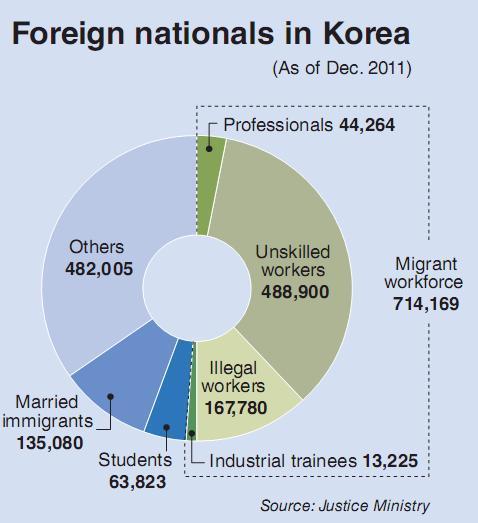
Today, almost no trace of such hostility remains in the Korean economy, which in 2011 was ranked 7th and 9th in total international exports and imports, respectively. However, Korea is still characterized by a populational homogeneity that has only now begun to diversify with the influx of foreign migrants. As a member state of the prestigious 20-50 club, an exclusive group of countries (7 total) with a per capita income exceeding 20,000 USD, and a population of over 50 million, Korea provides an ideal environment for many investors, foreign workers, and exchange students. While Western travelers described local hospitality as "their most distinctive impression of Korea," Koreans have been known to discriminate and treat poorly visitors from other Asian countries, especially those that come to the country with purposes beyond tourism or temporary study. At the crux of this conflict is the rising presence of foreign marriage migrants and long-term laborers.Laborers, especially those from South Asia, are leased to enter the country under the competitive "Employment Permit System Recruitment," a system that delegates immigrants jobs in manufacturing, construction, agriculture, and fishery that have often been classified as "DDD" (dirty, dangerous, demeaning). Even after entering Korea, such laborers are only guaranteed two 4.5-year residencies, just short of the 5 year requirement for permanent residency. Unfortunately, such unfair policy is merely a reflection of Korean sentiment, which is piled high against immigrants.
One of many Korean visas issued to foreigners entering Korea for work. Continual restrictions on the issuance of visas has not discouraged foreigners who compete fiercely for the coveted legal acknowledgement.

Another group facing strong persecution in Korea is migrant spouses. While 86% of laborers are male, nearly all entering spouses are Asian women, following their husbands to a foreign land, where they are often shunned for their distinct appearance and inability to speak Korean. Many of these women follow their husbands for the rich economic opportunities in Korea, which can translate to remittances for struggling family members back home. Unfortunately, children of these "multicultural families" often face the brunt of prejudice. Despite identifying as Korean, many are shunned by their peers and teachers due to their mixed bloodline; those unable to afford school are often under-educated and unable to speak proper Korean or gain a high paying job. Unlike in other destination countries, migrants in the Korean Peninsula are isolated from mainstream Korean society for life, and the government is only now beginning to enact infrastructure protecting foreigners' rights.
Foreign wives assimilate to a new life in Korea through cultural immersion activities such as making the side dish kimchi.

In 2008, the Korean government released an "Act on Support for Multicultural Families." Recognizing the increasing percentage of "multicultural families," the legislature sought to organize efforts at integrating foreign mothers and their half-Korean children into regular society, while also defending migrant laborers' rights against work-related prejudice. Recently, several NGOs in the country have released a myriad of suggestions specifically targeting youth integration into the economy/society. The proposed solutions include, but are not limited to translating official documents and educational guidebooks into common minority languages(also provides jobs for immigrants), creating a government-funded network of multicultural families to allow greater communication and representation, providing extra Korean language classes especially for resident aliens (can be founded in partnership of the Office of Education and local community colleges). However, none of these solutions have yet been  implemented, and current infrastructure reveal a disinclination for the maintenance and funding of integration programs. So why do foreigners continue to flock to the Korean Peninsula? Beyond the obvious economic reasons, immigrants to Korea gain access to a much broader job market, and comparatively equal opportunities regardless of gender. Koreans are grudgingly tolerant of foreign laborers, for not only do they fill the undesirable "manual labor" roles, but the current system encourages temporary stay, which provides migrant labor on a temporary basis, meeting the seasonal demands of industries such as agriculture or fishing, without the obligation to provide for their welfare. Additionally, Korea has one of the world's lowest birth rates, at a meager 1.3 children per woman (Ministry of Health and Welfare). Korea's population is estimated to continue decreasing over the next few decades, due to a social environment in which women are more often choosing to work, instead of getting married and rearing the next generation. In this manner, migrant wives have been instrumental in providing children for many young Korean males who find themselves without a partner.
Korea's quickly rising foreign population. Statistics have risen significantly since this study was conducted in Dec. 2011.

Korea, previously a country unmentioned on world maps, is now one of the most appealing destination nations for international migrants. Where the US was once the paragon for economic opportunity, the Korean Dream is now fueling the paths of many migrants, especially in Southern Asia. Though the government and people are encountering many obstacles in accommodating the new residents, Korea must recall the policy decisions of other destination countries, including the US and Canada, and gradually build an environment of not only tolerance, but respect.

Sunday, June 29, 2014

Frogs in a Well: Resolving the crisis of Small Arms Proliferation

In the United Nations, the main goal of the General Assembly and other collective bodies of nations is to pass resolutions that offer policy recommendations to state governments and the action-charged Security Council. While normally unable to directly cause actions to happen, these resolutions are the result of great negotiation between nations, and can inspire very specific change in the international community. Model United Nations attempts to model this collaboration and develop policy ideas by pitting student delegates (each representing a different country) against one another on the United Nations floor. Take a look at the below resolution, passed in the Disarmament and International Security at the 2014 UCLA MUN Summer Institute. The different nations' policies that went into the development of the resolution is a true widening of perspective, opening up the mouth of our "world view well."

 United Nations
General Assembly

Committee: Disarmament Commission
Topic: Regulating the Illicit Proliferation in Small Arms
Sponsors: Italy, Poland, Spain, Costa Rica, Japan
Signatories: Sweden, Mexico, South Korea, Belgium, Lithuania, Greece, United Kingdom, Brazil, Argentina, Australia

Keeping in mind the Arms Trade Treaty as originally signed, especially articles 7 & 8 in regards to the import and export of small arms,

Recognizing the individuality of countries and the need for a resolution that properly addresses the subtle variances in nations’ policies,

Recalling the Charter of the United Nations article 26, which established the need for an arms regulation system, and article 51, highlighting the inherent right of individual self-defense for international peace and security,

Affirming the sovereignty of individual states in the right to bear arms,

Considering the role of small arms export in arms-producing countries as a valuable industry

Highlighting the impact of the UN Firearms Protocol in declaring the illegal manufacture of small arms a criminal offense,

1. Urges the establishment of realistic goals in working toward small arms disarmament by:
  1. reducing small arms production by 10% every 5 years for the next 25 years to work for gradual complete disarmament,
  2. creating an international body tasked with overseeing stockpile reduction,
  3. mandating that all member states of the international body report back to the committee annually on disarmament progress;

2. Recognizes the inability of countries to impose anti-proliferation measures and provides     financial support to countries that need it by:
a. Reasserting the points previously stated by the Arms Trade Treaty (ATT),
b. Further proposing the implementation of an international tracing system:
i. amends the jurisdiction of the UN International Tracing Instrument by increasing     the consequences to states for refusal to cooperate with the terms of the treaty,
ii. promotes transparency and communication between states to facilitate an international movement toward combating the illegal trade;

3. Implements the Arms Recycle Program:
a. In which individuals turn-in guns to their respective governments which then melts and recycles them into useful products:
i. fulfills the demand for jobs in the industry,
ii. increases economic development and independence as recycling plants will be constructed directly in the affected countries;
b. In which governments will incentivise individuals with monetary compensation,
i. requests funds from NATO, the European Union, and the United Nations General Assembly to implement this program,
c. In turn, the UN will build infrastructure to governments in exchange for reaching a target number of arms;

4. Proposes the development of a guns registration system in all arms-producing countries
a. Functioning at the site of arms producing factories in order to prevent the transfer of guns outside of the country before registration,
b. Designates a serial number for every small arm in production in order to track the distribution of individual small arms.

5. Recommends the implementation of legislation which would increase the punishment for owning or possessing any illegal small arm

Friday, June 20, 2014

Fighting for a Voice Against the 'National Security Law'

“Everyone has the right to freedom of opinion and expression; this right includes freedom to hold opinions without interference and to seek, receive and impart information and ideas through any media and regardless of frontiers.” – Article 19, Universal Declaration of Human Rights

South Korea, famed for developing the world’s fastest broadband internet connection, made large strides in the early 1950’s to promote freedom of speech as an inherent aspect of its new democracy. However, especially in the 21st century, the press situation has gradually come to reflect Korea’s internal turmoil as it struggles to avoid collision with the threats of North Korea’s capricious monarchy. In 1948, the passage of the National Security Law (NSL) attempted to protect South Korean government from Communist interference by banning all activity that promoted the spread of North Korea propaganda or criticized the South Korean government. If such a law had not been passed through the National Congress, it is likely that South Korean society would be under constant attack by the writings of Northern spies and left-wing enthusiasts. However, the relative peace of today’s democracy comes at the cost of free communication and “genuine exchange of ideas” between the people of North and South Korea. According to analysts including Paul Roderick Gregory, the Korean people hold the key to overthrowing the Northern regime and peacefully integrating the two adverse countries. With the threat of censure under the National Security Law though, bloggers, journalists, and the common people (over 84% of Koreans have access to 3G and wireless internet) are prevented from interacting sincerely with their Northern counterparts. Without the incentive for genuine communication, Koreans lack empathy for one another, and are trapped in a never-ending cycle of separation, misunderstanding, and ever-deepening schism. Current-president Park Geun-hye strongly advocates a unified and peaceful Korea; however, as long as the NSL continues to be enforced, I am not alone in my concerns as to the candor behind her declarations. Under the National Intelligence Service (NIS), the National Security Law has made a gimcrack of the accepted code on freedom of speech. As expressed by UN Watch Director Hillel C. Neuer, “The lifeblood of democracy is… the freedom of press.” The law’s broad application to all publications “praising, encouraging, or propagandizing” on behalf of North Korea has meant that it has been used to justify nearly all forms of media censorship. Yet the consequences of this act reach much farther than social media and online news sites.


Last fall, a member of the far-left United Progressive Party (UPP) was indicted for supporting “an insurrection against the South in the case of North Korean invasion.” The National Intelligence Service has arrested the lawmaker on scant evidence, and taken moves to disband his party, which was originally the third most-powerful body of the National Congress. It’s worth mentioning that the NIS’s actions were greeted by ambivalent responses; lawmakers in the majority and far-right approved and continue to support the security law as a necessary precaution against the dispersion of Communist ideals. However, this enforcing body may also be partaking in the very actions that the NSL was meant to prevent. According to prosecutions last June, the intelligence service planted numerous posts through social media denouncing the president’s far-left opponent as a North Korean sympathizer. I daresay that unless decisive actions are taken to limit the interpretation of the National Security Law, its abuse of human freedoms will cause the Korean political and social sectors to crumble from the inside. 

Monday, June 16, 2014

Frogs in a Well: Proliferation of Small Arms

From the desk of the Spain mission to the United Nations: speaking on the illegal spread of small arms/ light weapons, and ammunition. Though inevitably a dangerous addition to the growing culture of violence and warfare, small arms in the wrong hands can lead to increased cases of human rights abuse, domestic violence, terrorism, and organized crime. In nations such as Somalia or sub-Saharan Africa, it has even led to the culmination of child soldier troops. Take a look beyond the oppressive walls of your world view; how might these "mortal instruments" be viewed in the distinctive Iberian peninsula?

Disarmament and International Security Committee
Spain
Proliferation of Small Arms

The use of small arms, a practice clearly harmful to state security has become much more common throughout the world as an extension of the universal right to self-defense (United Nations Charter, Article 51). In sub-Saharan Africa, the lack of government military protection has forced populations to fall back on this inherent right and take up arms to form local militias; the large quantity of SALW (small arms and light weapons) circulating through towns in countries like Liberia, Somalia, and Sudan constitute only a small portion of the vast international arms trade. Much of the weaponry in circulation is sold by countries in central and Eastern Europe, which arm civilians, terrorists, and combatants alike to earn revenue from their Cold War SALW stockpiles. In Mexico, the wide availability, low cost, and easy concealment of small arms have prolonged the drug war indefinitely, arming drug trafficking gangs and causing over 10,000 civilian deaths in the span of two years. The international community is unable or unwilling to register each of the small arms in storage or manufactured today, leading to a world-wide culture of warfare that is slowly toppling the social order.
 The United Nations holds a policy of non-tolerance against small arms trade, as originally spelled out in the Charter of the United Nations (Article 26). In 2001, the General Assembly passed the Protocol Against the Illicit Manufacturing of and Trafficking in Firearms, their Parts and Components and Ammunition (55/255) when it convened for the Convention against Transnational Organized Crime. As the first international agreement addressing small arms, this protocol established the illegal manufacture of conventional weapons as a criminal offense. Additionally, it recognized the need for the marking and tracing of firearms in production. Through the approval of the Arms Trade Treaty (2012), the UN furthered its commitment to regulated trade by setting standards on cross-border checks of conventional weaponry, preventing the transfer of small arms for purposes including human rights abuse, organized crime, or violations of humanitarian law. Efforts to block the misuse and illegal handling of conventional weapons have been supported by the actions of NGOs, including the United Nations International Child Emergency Fund (UNICEF), International Criminal Police Organization (Interpol), and the World Customs Organization. Several of these organizations have sent recommendations to the United Nations based on its Firearms Protocol, while UNICEF has also organized the International Action Network on Small Arms, a forum of over 300 NGOs gathered specifically to address the impact of small arms culture on youth.
As a member state of the European Union, Spain condemns the illegal arms trade to unstable countries, especially in the African Union. Despite being ranked from 2001-2008 as a major exporter of SALW and ammunition, Spain references its constant implementation of rigorous law enforcement as proof of its stance. Spain has consistently demonstrated its support of arms regulation through ratification of the UN Protocol on Firearms, and approval of the EU Joint Action Plan (2002/589/CFSP). Spain regards instability due to political conflicts to be the major cause for small arms demand in third world countries. Therefore, Spain implores the UN to develop a legally-binding international committee to monitor of sanctions on light weapons and the illicit trade of raw resources in Africa. This committee would also be tasked with the marking and tracing of all small arms involved in cross-border transfers,so that illegal weaponry is not flown into terrorism, organized crime, and dismantling of state structure. Spain also encourages the UN to take preventive action by providing the African Union and Latin America with the means for effective application of UN sanction regimes. While Spain recognizes the inherent right to bear arms, it proposes that by strengthening law enforcement in unstable nations, local militias will not feel as great a need for self-defense and stocks of SALW obtained from the cross-border smuggling. Spain realizes that countries in the European Union are among the largest suppliers of small arms to international demands, and strongly urges fulfillment of stockpile reduction policies. In addressing both supply and demand for small arms, Spain reiterates that an aggressive policy against small arms proliferation will benefit all United Nations member states, ushering in a world free of these hidden dangers to the social state.
Works Cited

United Nations Peacekeeping. “Disarmament, Demobilization, and Reintegration.” Accessed on 9 June 2014. http://www.un.org/en/peacekeeping/issues/ddr.shtml

United Nations. Report of the United Nations Conference to Review Progress Made in the Implementation of the Programme of Action to Prevent, Combat and Eradicate the Illicit Trade in Small Arms and Light Weapons in All Its Aspects. General Assembly. Accessed on 8 June 2014. http://www.un.org/events/smallarms2006/pdf/rc.9-e.pdf

Programme of Action. “Firearms Protocol Background.” Accessed on 10 June 2014. http://www.poa-iss.org/FirearmsProtocol/FirearmsProtocol.aspx

United Nations Treaty Collection. “Chapter XVIII 12.c. Protocol against the Illicit Manufacturing of and Trafficking in Firearms, Their Parts and Components and Ammunition.” Accessed on 7 June 2014. https://treaties.un.org/Pages/ViewDetails.aspx?src=TREATY&mtdsg_no=XVIII-12-c&chapter=18&lang=en

Secretariat.  EU Strategy to combat illicit accumulation and trafficking of SALW and their ammunition. Council of the European Union. Accessed on 13 June 2014. http://register.consilium.europa.eu/doc/srv?l=EN&f=ST%205319%202006%20INIT

World Customs Organization. “Firearms / Explosives.” Accessed on 12 June 2014. http://www.wcoomd.org/en/topics/enforcement-and-compliance/activities-and-programmes/ep_firearms.aspx